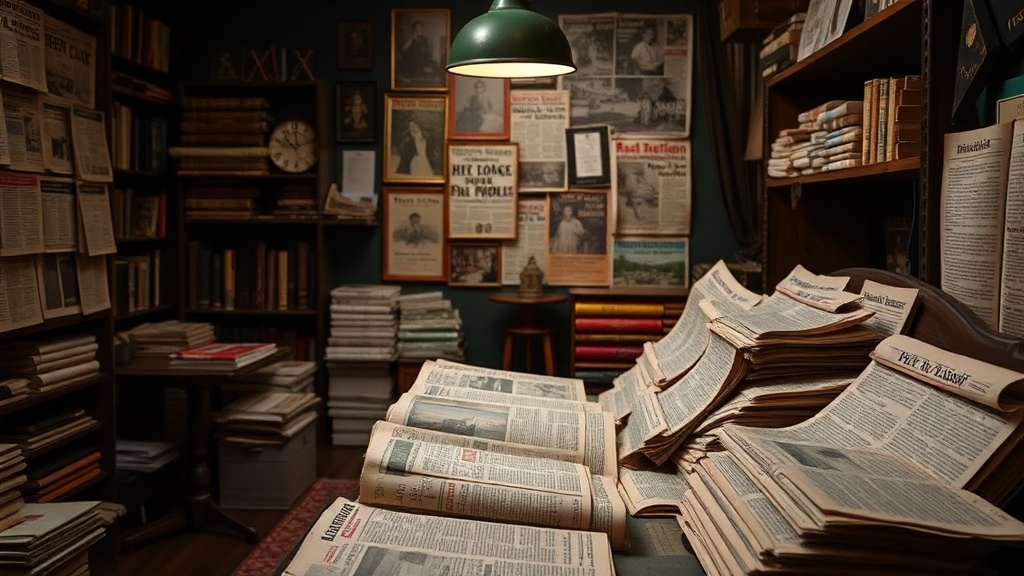
The Beginner's Guide to Collecting Vintage Newspapers

What This Guide Covers (and Why You Should Care)
This guide walks through everything needed to start a vintage newspaper collection—from spotting valuable issues at estate sales to storing them properly so they don't turn to dust. You'll learn which headlines matter (and which don't), how much to pay, and where serious collectors hang out. Whether you're drawn to WWII front pages, Victorian society columns, or baseball box scores from 1927, vintage newspapers offer an affordable entry point into collecting tangible history. Most issues cost between $5 and $50. Some are worth thousands. Knowing the difference saves money and builds a collection worth keeping.
What Makes a Vintage Newspaper Valuable?
Three things: historical significance, condition, and scarcity. A crumpled 1969 moon landing extra might fetch $20. A pristine one with the original supplement? $200. The same headline, two very different prices.
Here's the thing—not every old newspaper is worth saving. A 1930s local weekly with routine farm reports and church social announcements probably won't appreciate. But that same paper covering the Lindbergh kidnapping? Different story. Collectors chase moment newspapers—issues documenting events that changed everything.
Key value drivers to watch for:
- Momentous headlines: Wars declared, assassinations, moon landings, championship wins
- Complete editions: Missing sections kill value—collectors want the whole package
- Large metropolitan dailies: The New York Times, Chicago Tribune, Los Angeles Times carry premium prices
- Special editions: Extras, late editions, " bulldog" early editions printed the night before
- Illustrated supplements: Color rotogravure sections from the 1910s–1930s are highly sought
The catch? Condition matters enormously. A newspaper with clean margins, no tape repairs, and minimal foxing (those brown spots from acid migration) can command 10x what a damaged copy brings. Professional grading services like PSA and CGC now encapsulate exceptional newspapers, though most collectors learn to grade themselves.
Where Should You Buy Vintage Newspapers?
Start local, then expand. Estate sales in older neighborhoods—particularly in the Northeast and Midwest—regularly produce boxes of newspapers stashed in attics. Antique malls carry them too, though prices run higher. Online marketplaces offer the widest selection but require sharp eyes.
Worth noting: eBay remains the largest marketplace, with thousands of listings daily. Search terms like "original newspaper 1945" or "Civil War newspaper" yield results, though reproductions and reprints abound. The eBay platform offers buyer protection, which matters when you're spending $300 on a claimed 1865 Lincoln assassination issue.
Specialized dealers offer curated inventory and guarantees of authenticity. Tim Hughes of Rare Newspapers has operated since 1975 and maintains an extensive online catalog with detailed condition notes. His inventory spans the 1600s through the 1970s, with prices from $15 to five figures.
Here's where to hunt:
| Source | Price Range | Best For | Caveats |
|---|---|---|---|
| Estate sales | $1–$20 per issue | Bulk buying, unexpected finds | Condition varies wildly; bring a flashlight |
| Antique malls | $15–$100 | Examining before buying | Overpriced common issues |
| eBay | $5–$5,000+ | Specific dates, graded copies | Reproductions sold as originals |
| Specialized dealers | $25–$10,000+ | High-value investments, authentication | Premium pricing |
| Library deaccession sales | $0.50–$10 | 19th-century regional papers | Duplicate holdings, binding holes common |
Auction houses like Heritage Auctions handle exceptional pieces—think Declaration of Independence era Pennsylvania Gazettes or 1929 crash editions with original stock tickers. Those sales attract serious collectors with serious budgets.
How Do You Store Newspapers Properly?
Poor storage destroys value faster than time itself. Newsprint is inherently acidic—that's why old papers yellow and crumble. Without intervention, a 1950s newspaper becomes brittle and fragments within decades. The right materials and environment can extend that lifespan to centuries.
That said, you don't need a museum-grade facility. A closet in a climate-controlled home works fine if you follow basic rules. Temperature should stay between 60–70°F with relative humidity at 35–50%. Basements and attics? Avoid them. Basements flood. Attics bake.
Storage supplies worth investing in:
- Archival folders and boxes: Look for acid-free, lignin-free materials rated "archival" or "museum quality." Gaylord Archival supplies libraries and museums with preservation-grade boxes. Their newspaper storage kits include buffered tissue and custom-sized enclosures.
- Mylar sleeves: Inert polyester film (DuPont Mylar D or equivalent) protects individual issues from handling damage and environmental pollutants. Don't use PVC—it's cheap but chemically unstable.
- Buffered tissue: Place sheets between pages to neutralize acid migration. Unbuffered tissue works better for color supplements (buffering can affect pigments).
- Flat storage: Never fold newspapers to fit shelves. Folding creates stress lines that eventually split. Store flat in appropriately sized boxes.
Handle newspapers with clean, dry hands—or better yet, cotton gloves. Oils from skin transfer to newsprint and accelerate deterioration. Support the entire page when turning; don't lift by one corner.
What Are the Most Collectible Eras and Events?
Certain periods dominate the market. The Civil War era (1861–1865) produces some of the most valuable American newspapers. Harper's Weekly—technically a magazine but collected alongside newspapers—featured stunning woodcut illustrations by artists like Thomas Nast. Original Civil War battle reports, Lincoln assassination coverage, and Reconstruction-era editorials command strong prices.
The World War II era (1939–1945) offers accessible entry points. D-Day editions, V-J Day announcements, and Hitler death reports remain affordable at $30–$150 for nice copies. Pearl Harbor attack extras—particularly "bulldog" editions printed December 7, 1941—start around $75 and climb based on condition and newspaper prominence.
Space race coverage attracts crossover collectors from the astronomy and science fiction communities. July 21, 1969 moon landing editions are common (millions printed worldwide) but still desirable. Earlier milestones—Sputnik (1957), Gagarin's flight (1961), Armstrong's spacewalk (1966)—appear less frequently.
Sports collectors drive demand for championship coverage. Here's the thing about sports papers—they're emotional purchases. A Red Sox fan will pay ridiculous money for a 2004 World Series Boston Globe because it means something personal. That same paper in St. Louis? Standard pricing.
Other hot collecting areas:
- Gangster era (1920s–1930s): Capone conviction, Dillinger death, Bonnie and Clyde shootouts
- Prohibition: Repeal headlines from December 1933
- 19th century illustrated: Pre-photography newspapers with hand-colored engravings
- Western expansion: Gold rush announcements, transcontinental railroad completion
How Can You Tell Real from Fake?
Reproductions plague the newspaper market. Most aren't malicious—museums and historical societies produced commemorative editions for decades. The problem comes when sellers (or ignorant heirs) present these as originals. A 1962 reprint of an 1862 Civil War edition looks old to untrained eyes.
Authentication starts with the basics. Check the date format—newspapers printed "Monday, July 4, 1864" not "July 4, 1864" (modern style). Examine the paper stock; 19th-century newsprint has distinct texture and often visible fibers. Hold it to light—modern paper is uniformly white, while antique stock shows age patterns.
Look for library stamps, binding holes, or subscription labels. These "defects" actually authenticate age—reproductions rarely include them. Smell the paper (gently). Old newsprint has a distinct musty-but-not-moldy aroma. Chemical aging smells different than genuine antiquity.
Worth noting: Some reproductions are collectible themselves. The 1976 Bicentennial reproductions of famous colonial newspapers were produced in limited quantities and carry modest value to specialized collectors. But they're not the 1776 originals they resemble.
When spending serious money, demand provenance. Where did the seller acquire this? Reputable dealers provide documentation. Auction houses guarantee authenticity—or refund your money. Private sellers on Craigslist or Facebook Marketplace? You're on your own.
Building Your Collection: A Practical Starting Point
Pick a focus. "Everything" isn't a collection—it's accumulation. Narrow by era (Depression newspapers), subject (aviation milestones), geography (your home state), or newspaper title (complete run of The Saturday Evening Post). Focus makes hunting purposeful and builds expertise.
Set a budget and track spending. It's embarrassingly easy to drop $500 at an estate sale on "bargains" that duplicate what you already own. Maintain a simple spreadsheet: date, publication, headline significance, condition, purchase price, source. This inventory proves invaluable for insurance and eventual resale.
Join the community. The American Newspaper Collectors Association connects enthusiasts through newsletters and annual gatherings. Online forums at Collectors Society and Reddit's r/vintagepapers offer identification help and market insights. Serious collectors share knowledge freely—it's a friendly community.
Visit archives and museums. The Library of Congress maintains vast newspaper collections accessible online through Chronicling America. Seeing pristine examples trains your eye for condition assessment. The Newseum (now dispersed but with online archives) showcased journalism history through original front pages.
Start small. Buy a WWII D-Day edition in decent shape for $40. Learn to examine it, store it, appreciate it. Then buy another. Collections grow one paper at a time. The hunt matters as much as the acquisition—maybe more.
"Vintage newspapers are time machines you can hold. Every issue connects you to specific people on specific days who learned something that changed their world. That connection doesn't depreciate."
The paper you buy today might outlast everything else you own. Choose wisely. Store carefully. Enjoy completely.